
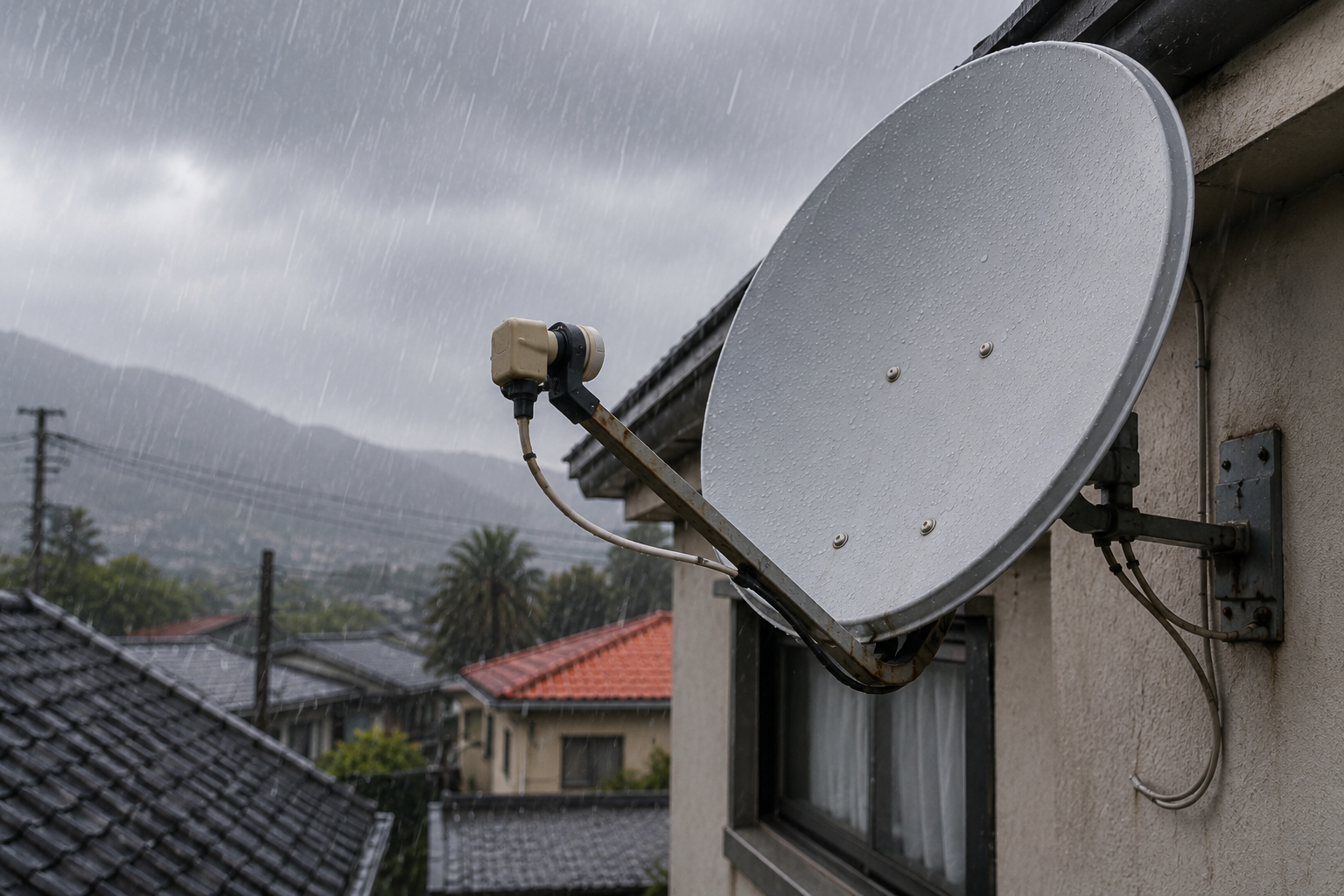
A DStv system can be working perfectly one day and suddenly become unreliable after a night of heavy rain or strong wind. The picture may start pixelating, channels can freeze, sound may disappear, or the decoder may eventually show a signal error.
Sometimes the problem clears up as soon as the weather improves.
Other times, the storm passes and the DStv still does not work properly.
That difference matters.
Heavy rain can temporarily interfere with satellite reception, so a short-lived signal interruption during a severe downpour does not automatically mean that anything has been damaged. DStv explains that this is known as rain fade and that heavy downpours can interrupt satellite reception. However, DStv also states that overcast conditions, drizzle and normal rainfall should not ordinarily cause signal problems. Persistent reception problems in those conditions can indicate that a dish is not optimally installed or properly fine-tuned.
Strong wind is a different concern. A satellite dish needs to remain accurately positioned, and movement of the dish or its mounting can affect reception even when there is no obvious physical damage.
For DStv customers in Cape Town, this means a storm can be the cause of a temporary interruption, but it can also reveal a problem that needs proper attention.
Request DStv Signal Troubleshooting
If your DStv signal has not returned to normal after the storm, fill in the form below to request professional troubleshooting for your existing installation.
What Can Happen to Your DStv During Severe Weather?
Satellite television depends on a signal travelling between the satellite and the dish at your property. That signal has to reach the dish clearly enough for the decoder to process it and provide a stable picture.
Severe weather can interfere with this process.
During an intense downpour, you may notice the picture becoming blocky or freezing. Sound may cut out at the same time. Some channels may disappear temporarily, and in a particularly heavy storm the entire signal may be lost.
This is not necessarily a sign that your equipment has failed.
DStv explains that rain fade can occur because satellite signals become weaker as they pass through raindrops. It also notes that the location of the storm matters, meaning weather affecting another part of the signal path can contribute to reception problems even if conditions directly above your home are different.
That is why the first thing to consider after a major storm is whether the problem is temporary.
If reception returns when the weather settles and the system then works normally again, you may simply have experienced weather-related signal loss.
The situation becomes more concerning when the weather improves but your DStv remains unreliable.
Heavy Rain Does Not Automatically Mean Your Dish Is Damaged
It is easy to assume that something must have broken when the picture disappears during a storm.
Not necessarily.
DStv specifically acknowledges that heavy downpours can cause temporary signal interruptions and describes this as a feature of satellite television systems.
This is important because it means you should not immediately arrange a dish replacement simply because your DStv stopped working during an intense storm.
Give the weather an opportunity to clear.
Once the rain becomes lighter, watch what happens to the reception.
If the picture gradually returns and remains stable afterwards, there may not be a fault requiring repair.
If the signal remains unavailable long after the storm has passed, however, that is a different situation.
The same applies if your DStv has become noticeably more sensitive to ordinary weather than it used to be.
A system that only struggles during an exceptionally heavy downpour is behaving differently from one that starts pixelating whenever there is light rain.
What Strong Wind Can Do to a Satellite Dish
Wind can be more relevant to the physical installation than rain.
A satellite dish is mounted outdoors and needs to remain in a precise position. Strong gusts place pressure on the dish and its mounting hardware, particularly when the dish is installed in an exposed position.
If the dish moves, even slightly, its alignment can change.
The important point is that the dish does not have to fall off the wall or look dramatically crooked for reception to be affected.
A small change can be enough to reduce signal performance.
You might therefore notice the problem only after the storm, when the weather has already improved.
This can create a confusing situation: the rain has stopped, the wind has died down, but the DStv is still pixelating or showing a signal error.
In that case, the storm may have been responsible for changing the physical position of the dish rather than simply causing temporary signal interference.
DStv states that correct satellite dish alignment is directly related to installation performance.
Your Dish May Look Fine and Still Need Attention
One of the easiest mistakes to make after a storm is assuming that the dish is fine because it looks fine.
From the ground, the dish may appear to be in exactly the same position as before.
The bracket may still be attached.
The dish may not have any obvious dents or cracks.
The LNB may still be sitting on the end of the arm.
None of this confirms that the dish is still accurately aligned.
Satellite alignment is precise. A dish that has shifted slightly may continue to receive some signal while performing less reliably than before.
That can produce symptoms such as intermittent pixelation, freezing or signal loss whenever conditions become less favourable.
This is why visual inspection can identify obvious physical damage but cannot reliably confirm alignment.
When Heavy Rain Is Probably Just Temporary Rain Fade
There is a useful pattern to look for.
If your DStv was working normally before the storm, loses reception during an exceptionally heavy downpour and returns to normal once the weather clears, temporary rain fade is a reasonable explanation.
You may not need an installer for every such occurrence.
DStv explains that heavy rain can weaken satellite signals and cause temporary interruptions.
The important part is what happens afterwards.
If the system returns to its usual performance, there may be nothing more to do.
If it continues pixelating, freezing or losing signal after the storm, the weather may have exposed another issue.
That is where troubleshooting becomes more important.
When the Weather May Be Exposing an Existing Problem
A storm can sometimes reveal a weakness that was already present in the installation.
Imagine that your dish is slightly out of alignment.
On a clear day, the signal may still be strong enough for your decoder to provide a normal picture.
Then a heavy rainstorm weakens the signal further.
The system starts breaking up.
Once the rain stops, the picture might improve, but the underlying alignment problem remains.
The next time there is rain, the same thing happens again.
This pattern can make it seem as though the rain is causing the problem every time, when the more accurate explanation is that the installation has limited signal margin.
DStv’s guidance is particularly useful here. It says that normal rainfall, drizzle and overcast conditions should not ordinarily cause signal problems. If they do, the dish may not be optimally installed or properly fine-tuned.
That makes recurring problems during mild weather worth investigating.
Your DStv Keeps Pixelating After the Storm
Pixelation is often one of the first signs that reception is not stable.
Instead of displaying a smooth image, the picture breaks into small blocks or distorted sections. The programme may continue playing underneath the distortion, or the picture may freeze completely.
If this only happens during an exceptionally heavy storm, weather-related interference may explain it.
If the pixelation continues after the storm or has become a regular occurrence, the signal path should be considered.
Possible areas for investigation include the dish alignment, LNB, cabling and connections.
DStv identifies damaged cables, loose connections and an improperly aligned dish among possible causes of inadequate satellite signal.
That is why persistent pixelation should not simply be dismissed as “Cape Town weather”.
The Signal Comes Back, Then Disappears Again
Intermittent reception can be more difficult to diagnose than a complete loss of signal.
You might get your picture back after the rain stops, only for it to disappear again a few hours later.
Or the system may work perfectly in the morning and start freezing whenever the wind picks up.
This type of pattern is worth documenting.
If the problem is consistently connected to weather, there may be a weakness in the installation that becomes more noticeable under less favourable conditions.
A dish that is slightly misaligned is one possibility.
An ageing LNB or deteriorating cable can also behave intermittently.
The fact that the signal sometimes returns does not necessarily mean the installation is healthy.
It simply means the system is capable of receiving enough signal under some conditions.
What If the Problem Only Happens When It Rains?
This depends on how much rain is involved.
A severe downpour can cause temporary rain fade. That is expected behaviour from satellite systems, and DStv confirms that heavy rain can interrupt reception.
Light rain is different.
DStv specifically states that customers should not normally experience signal problems during drizzle or normal rainfall. If your DStv consistently becomes unreliable under those conditions, the dish may not be optimally installed or properly fine-tuned.
That is an important distinction for homeowners.
If your television only struggles during a very intense storm, you may simply be seeing the effects of rain fade.
If a mild shower regularly causes pixelation, freezing or signal loss, there is a stronger reason to investigate the installation.
Strong Wind Can Affect More Than the Dish Position
The dish itself is not the only part of the outdoor installation exposed to wind.
Mounting hardware, brackets and cabling are also outside.
A strong storm can place additional strain on the mounting structure. If something becomes loose, the dish may no longer remain in exactly the position in which it was originally aligned.
Outdoor cabling can also be affected by years of exposure.
That does not mean every storm will damage a cable or bracket. It simply means that an installation that has already developed wear may become more vulnerable during severe weather.
If reception problems started immediately after strong wind, mention that when arranging an assessment.
The timing can provide an important clue.
What About the LNB?
The LNB is the receiving component mounted on the satellite dish. DStv describes it as the part that collects radio waves from the dish and converts them into a signal that the decoder can understand.
Because the LNB sits outside, it is exposed to the elements.
A storm-related reception problem does not automatically mean the LNB has failed, but it is one of the components that may need to be considered if the signal remains unstable.
This is particularly relevant when the problem continues in clear weather.
An LNB issue can produce symptoms that overlap with dish alignment and cabling problems, so it is not sensible to replace it simply because the picture is pixelating.
A proper assessment can help determine whether the LNB is contributing to the reception problem.
Damaged or Loose Cables Can Become More Noticeable After Bad Weather
The cable carrying the satellite signal from the dish to the decoder needs to maintain a reliable connection.
A loose connection can interrupt reception.
A damaged cable can reduce signal performance.
Outdoor cabling can also deteriorate over time due to continued environmental exposure.
DStv’s troubleshooting advice for signal errors recommends checking that the cables from the satellite dish are properly connected to the decoder when weather is not responsible for the problem.
If the accessible connection behind your decoder is loose, that is something you can safely check without climbing onto the roof.
Do not pull hard on the cable or attempt to dismantle outdoor connections.
If the cable itself appears damaged or the problem persists after checking the accessible connections, professional troubleshooting is more appropriate.
What If the DStv Signal Does Not Return After the Rain?
This is when you should stop assuming that the problem is temporary.
If the storm has passed and the sky has cleared but the decoder continues to show a signal error, check the accessible cable connections and restart the decoder.
DStv recommends switching the decoder off at the wall plug, waiting at least 10 seconds and then switching it back on when troubleshooting E48-related signal problems.
If reception remains unavailable, there may be a problem with the installation.
The dish could have shifted during the wind.
A connection could have been disturbed.
The LNB or cable could have a fault.
There could also be another issue affecting the signal.
At this point, repeatedly restarting the decoder is unlikely to solve a physical installation problem.
Request Professional DStv Fault Finding
If your DStv signal has not returned after the rain has cleared and basic checks have not helped, fill in the form below to request professional fault finding and determine what has been affected.
How to Tell If the Storm Actually Caused the Problem
Timing is one of the most useful clues.
Ask yourself what the system was doing before the weather changed.
If the DStv was reliable for months and then suddenly became unreliable immediately after an unusually strong storm, there is a reasonable connection between the two events.
But there is another possibility.
Perhaps the DStv had already been pixelating occasionally before the storm.
Perhaps reception had become increasingly sensitive to light rain.
Perhaps you had already noticed that the signal was weaker than it used to be.
In that case, the storm may have simply made an existing problem impossible to ignore.
This distinction is important because the solution is different.
Temporary rain fade requires patience.
A physically affected or poorly performing installation requires troubleshooting.
What If the Dish Was Recently Installed?
A storm can also reveal problems with a relatively new installation.
If a newly installed system has poor reception after the first major period of bad weather, it should not automatically be assumed that the storm damaged it.
The installation itself may need to be assessed.
DStv states that equipment performance is directly related to installation quality, including correct dish alignment and the use of approved equipment.
If reception was never consistently reliable from the beginning, that is a different situation from a long-standing installation that suddenly became unreliable after years of good performance.
The history of the system matters.
What If the Dish Was Recently Moved?
A recently relocated dish is another situation where the timing can be important.
Moving a satellite dish changes its installation position, so accurate alignment is necessary at the new location.
If the system worked before the move but developed reception problems afterwards, the installation should be checked rather than assuming that the weather is responsible.
This is especially relevant if the relocation took place shortly before the storm.
A dish that was not correctly aligned after being moved may have appeared acceptable under favourable conditions and then become unreliable when the weather changed.
What If Only One TV Has Lost Signal?
The number of affected viewing points can help narrow down the problem.
If one decoder or television has lost signal while another continues working normally, the fault may be isolated to that viewing point.
The cable route, connection, decoder or other equipment serving that TV may need attention.
If every television connected to the same satellite system loses reception at the same time, the issue may be further upstream.
This can be particularly relevant for XtraView or additional TV point installations.
DStv recommends using an Accredited Installer for XtraView installations and notes that more complex setups can involve multiple decoders and specific installation requirements.
DStv Connect also provides services for additional TV points and more complex DStv installations, so the distinction between one affected viewing point and an entire system is useful when troubleshooting.
What If You Live in a Complex?
A person living in a freestanding home may have an individual satellite dish, while someone in an apartment or complex may use a shared satellite installation.
That changes how a storm-related signal problem should be approached.
If several residents lose signal at the same time, the issue may not be inside one apartment.
DStv specifically advises customers who live in complexes, share a dish, use XtraView or connect decoders to multiple TVs to consult an Accredited Installer about their installation.
If your building uses a communal satellite system, it is therefore useful to find out whether other residents are experiencing the same issue.
If everyone is affected, the problem may be within the shared infrastructure.
If only your unit is affected, the issue may be closer to your individual connection.
Should You Adjust the Satellite Dish After Strong Wind?
It is better not to.
It can be tempting to climb up and move the dish back into what looks like the correct position.
The problem is that satellite alignment is precise.
Moving the dish by eye can easily make the reception worse.
There is also a safety concern if the dish is mounted on a roof, high wall or another difficult-to-reach position.
A safer approach is to have the dish and its mounting assessed professionally.
If the dish has moved, accurate realignment can be carried out and the signal can be checked rather than relying on guesswork.
What Can You Safely Check Yourself?
There are several basic checks that do not require you to touch the dish.
Start by looking at the weather.
If there is still an exceptionally heavy downpour, wait for conditions to improve before assuming that something has been damaged.
Once the weather has cleared, check the accessible cables around the decoder. Make sure nothing has been accidentally disconnected.
You can also restart the decoder following DStv’s recommended procedure.
Then observe what happens.
Does the picture return completely?
Does it remain pixelated?
Does the signal disappear again when the wind picks up?
Does the problem occur even though the sky is clear?
These details are useful when deciding whether the problem is likely to be temporary or whether the installation needs attention.
Do not climb onto the roof to inspect or adjust the dish.
When Should You Call a DStv Installer?
A single signal interruption during an exceptionally heavy storm does not necessarily mean you need an installer.
There is a reasonable chance that the weather is temporarily interfering with reception.
Professional help becomes more appropriate when the problem continues after the weather clears or repeatedly occurs during ordinary conditions.
You should consider an assessment if your DStv:
- Remains without signal after the storm has passed
- Continues pixelating or freezing on clear days
- Has become unusually sensitive to light rain or drizzle
- Started experiencing problems immediately after strong wind
- Has recurring signal errors
- Has a dish that appears to have shifted
- Has visible damage to outdoor equipment or cabling
- Was recently installed, relocated or modified
- Has multiple viewing points experiencing the same problem
None of these signs automatically proves that the dish needs replacement.
They simply indicate that the installation should be assessed rather than continuing to blame the weather.
Why a Storm Can Reveal a Weak DStv Installation
A well-functioning satellite installation is not completely immune to severe weather.
Heavy rain can cause temporary rain fade even when the installation is working properly. DStv confirms that intense downpours can interrupt satellite reception.
But an installation that is already operating with limited signal performance may be much more vulnerable.
A slightly misaligned dish, ageing LNB or compromised cable can continue functioning under favourable conditions.
Then a storm arrives.
The additional interference pushes the system beyond the point where it can maintain stable reception.
Afterwards, the homeowner may notice that the DStv is now more sensitive to weather than before.
This is why a storm can sometimes be the event that exposes the problem rather than the entire cause of it.
Why Replacing the Decoder May Not Solve a Weather-Related Signal Problem
The decoder is often blamed because it is the equipment sitting next to the television.
But a DStv signal has to reach the decoder before the decoder can process it.
If the dish has shifted, replacing the decoder does not realign it.
If the LNB is faulty, a new decoder does not repair the LNB.
If the cable is damaged, replacing the decoder leaves the damaged cable in place.
DStv’s own E48 troubleshooting guidance identifies the dish, cables, connections and severe weather as possible causes of inadequate signal.
That is why signal troubleshooting should come before assuming that a new decoder is required.
The aim is to find out where the problem actually is.
Why the Entire Installation Matters
A DStv satellite system is made up of several components that have to work together.
The dish needs to be correctly positioned.
The LNB needs to function properly.
The cabling and connectors need to provide a reliable signal path.
The decoder needs to receive and process that signal.
If any part of the system is compromised, the symptoms can appear on the television.
This is why DStv says the performance of its equipment is directly related to installation quality and correct satellite dish alignment.
It also explains why professional troubleshooting is more useful than replacing components based on guesswork.
What If the Problem Keeps Happening After Every Storm?
If your DStv loses signal after every major storm, start paying attention to what happens between storms.
Does it work perfectly for weeks?
Does it struggle during ordinary rain?
Does pixelation occur on windy days?
Does the signal become progressively worse?
Does the picture recover completely or only partially?
The answers can help determine whether you are dealing with normal temporary weather interference or an installation that has become unusually vulnerable to weather.
You should not expect satellite television to remain completely unaffected during every severe storm.
But you also should not assume that recurring reception problems during mild conditions are simply something you have to live with.
DStv specifically says normal rainfall and drizzle should not ordinarily cause signal problems.
If they consistently do, there is a reason to investigate.
When the Weather Clears but Your DStv Still Does Not
A storm-related DStv problem becomes more significant when the weather is no longer severe but the reception remains poor.
At that stage, basic checks are worthwhile.
Check the accessible connections.
Restart the decoder.
Observe whether the signal returns.
If it does not, the next step should not be repeatedly switching the decoder off and on.
The installation itself may need attention.
DStv Connect provides DStv installation and signal-related services in Cape Town and surrounding areas, including assistance with existing satellite systems.
A professional assessment can establish whether the dish needs realignment, whether the LNB or cabling needs attention, or whether another part of the setup is responsible.
DStv Signal Problems After a Storm: What Should You Do?
The first thing is not to panic.
If your DStv loses signal during an exceptionally heavy downpour, temporary rain fade is a genuine possibility. DStv confirms that severe rainfall can interrupt satellite reception.
Give the weather time to improve.
If the signal returns and your DStv goes back to normal, there may be no underlying fault.
If reception remains poor after the storm, look at the pattern.
A dish may have shifted during strong wind. A cable or connection may have been affected. An LNB may need assessment. The system may have already had marginal signal performance that the storm exposed.
If your DStv starts struggling during ordinary rain or drizzle, that is particularly worth investigating because DStv says those conditions should not normally cause signal problems.
And if the problem keeps returning, do not assume that another storm is always to blame.
Weather-related DStv problems can range from completely temporary interruptions to physical problems that need attention.
Heavy rain can cause rain fade even when the satellite installation is functioning properly. Strong winds can potentially affect the position or mounting of an outdoor dish. A storm can also expose weaknesses that were already present in the installation, such as marginal alignment, ageing equipment or compromised cabling.
The most useful clue is what happens after the weather improves.
If reception returns completely after an exceptionally heavy downpour, there may be nothing to repair.
If the signal remains unstable, disappears repeatedly, or starts failing during ordinary rain and drizzle, the installation should be investigated.
DStv Connect provides DStv installation and signal troubleshooting services for customers in Cape Town and surrounding areas. A professional assessment can help establish whether the problem is related to dish alignment, the LNB, cabling, connections or another part of the system.
The goal is not to replace equipment simply because a storm caused a temporary interruption. It is to determine whether your DStv system has returned to the reliable performance it had before the weather changed.
If it has not, that is when professional troubleshooting becomes worthwhile.
Request Your DStv Storm-Damage Signal Assessment
Has your DStv been pixelating, freezing or showing no signal since the last heavy rain or strong wind? Fill in the form below to request a professional assessment of your satellite installation.