
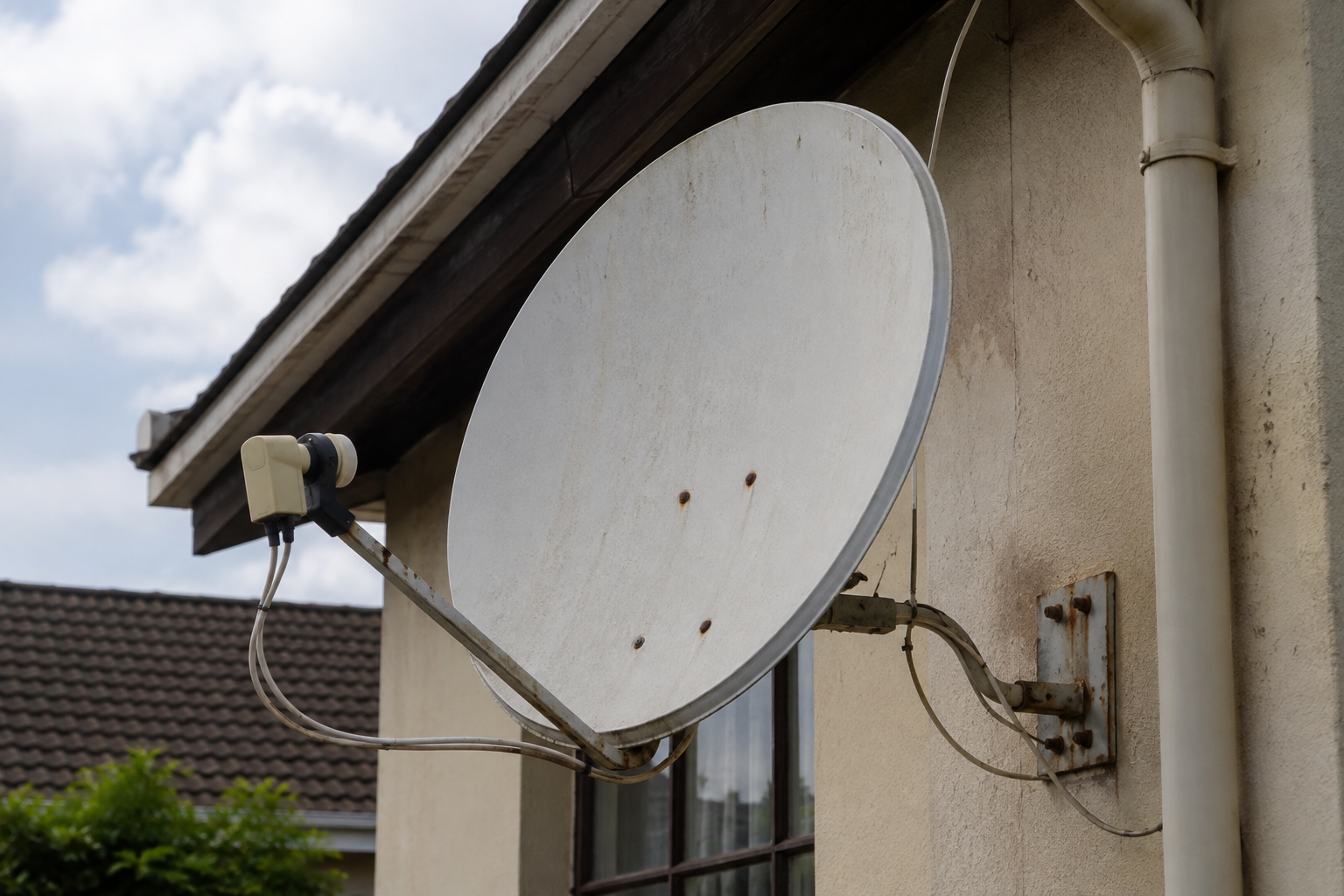
A DStv system does not always fail suddenly. Sometimes the first sign that something is wrong is a picture that becomes less reliable over time. Channels may start freezing occasionally, the picture may break into blocks, or the signal may disappear whenever the weather changes.
That can leave you wondering whether the problem is the decoder, the LNB, the cables or the satellite dish itself.
One possibility that is easy to overlook is dish alignment.
A satellite dish can still look perfectly normal from the ground while no longer being positioned as accurately as it should be. Strong wind, movement of the mounting structure, installation work around the property or a dish that was never properly fine-tuned can all contribute to reception problems.
The symptoms can also be misleading. A slightly misaligned dish may continue working under good conditions, only for the picture to become unreliable when rain or other interference weakens the signal further.
DStv confirms that the performance of its equipment is directly related to the quality of the installation, including correct satellite dish alignment. It also identifies an improperly aligned dish as one possible cause of inadequate signal reception.
So how can you tell whether your dish may need realignment?
Request a DStv Dish Alignment Assessment
Fill in the form below to request professional assessment of your DStv satellite installation.
What Does Satellite Dish Realignment Actually Mean?
Satellite dish realignment means adjusting the position of the dish so that it is accurately directed towards the satellite and can receive the intended signal properly.
It is not simply a matter of making sure the dish looks straight.
A satellite dish has to be positioned with a high degree of accuracy. If it moves even slightly from its intended position, reception can become weaker or less stable.
This is why a dish can appear to be physically intact while still having an alignment problem.
The dish might still be firmly attached to the wall. The LNB may still be sitting on its arm. The cable may still be connected. Nothing may look obviously broken.
Yet the signal can be noticeably worse than it was before.
DStv specifically states that the performance of its single-view equipment is directly related to installation quality, including the correct alignment of the satellite dish.
Realignment therefore involves more than simply moving the dish until a picture appears. The aim is to achieve reliable signal performance rather than finding a position that happens to produce a temporary picture.
The Most Obvious Sign: Your DStv Reception Has Become Unstable
One of the strongest clues that something may be wrong with the dish is a noticeable change in reception.
Perhaps your DStv used to work reliably for months or years, but you have recently started experiencing:
- Frequent pixelation
- Picture freezing
- Intermittent signal loss
- Channels disappearing temporarily
- Reception that becomes worse whenever the weather changes
- A picture that repeatedly breaks up before recovering
These symptoms do not prove that the dish is misaligned. A damaged cable, faulty LNB or another signal problem can produce similar symptoms.
What matters is the change in behaviour.
If your system previously handled ordinary weather without difficulty and has gradually become much more sensitive to rain or wind, the installation may be worth investigating.
A dish that is slightly out of alignment can still produce a usable signal under favourable conditions. When the signal becomes weaker, however, the problem can become much more obvious.
1. Pixelation Can Be a Sign of Weak or Unstable Reception
Pixelation is one of the most recognisable signs of a reception problem.
Instead of a smooth picture, the image breaks into small squares or blocks. Sometimes it lasts only a fraction of a second. At other times, the picture can become so distorted that the programme is almost impossible to watch.
If pixelation is happening repeatedly, especially when the weather is relatively normal, the satellite signal deserves attention.
Dish alignment is one possibility, although it is not the only one.
The important distinction is between occasional pixelation during a severe storm and persistent pixelation during normal viewing.
DStv explains that heavy downpours can cause temporary signal interruptions because rain can weaken satellite signals. However, it also states that customers should not normally experience signal problems simply because the sky is overcast, there is drizzle or there is normal rainfall. Persistent problems in those conditions can indicate that the dish is not optimally installed or properly fine-tuned.
That makes recurring pixelation during ordinary weather a useful warning sign.
2. Your DStv Keeps Freezing
A picture that freezes repeatedly can have several causes.
The decoder may be struggling because the incoming satellite signal is unstable. The dish could be slightly misaligned, the LNB could be experiencing a fault, or the cabling may not be carrying the signal reliably.
If freezing began after strong winds, dish alignment becomes particularly worth considering.
The timing is important.
Suppose your DStv worked normally throughout summer and then began freezing intermittently after a period of unusually strong wind. Nothing else in the system was changed.
That does not prove that the dish moved, but it gives you a sensible reason to have the dish and its mounting checked.
By contrast, if freezing started immediately after the decoder was moved and the television cabinet was rearranged, the connections around the decoder may deserve attention first.
Troubleshooting works best when the circumstances surrounding the fault are considered rather than focusing on one component immediately.
3. The Problem Gets Worse When It Rains
This is one of the most confusing signs because rain really can affect satellite reception.
DStv confirms that heavy downpours can cause temporary signal interruptions due to rain fade.
So if your picture disappears during an exceptionally heavy storm and returns when the rain passes, that does not necessarily mean your dish needs realignment.
The more revealing situation is when your DStv starts struggling during ordinary rainfall.
If a light shower that previously had little effect now causes pixelation or freezing, the installation may have limited signal margin.
A dish that is slightly misaligned may work acceptably in clear weather but become more vulnerable when the signal is weakened by rain.
This is why the question should not simply be, “Does my DStv stop working when it rains?”
A better question is:
How much weather does it take before my DStv starts having problems?
If severe weather is the only trigger, temporary rain fade may be the explanation.
If light rain, drizzle or even cloudy weather regularly causes reception problems, the dish and wider installation should be assessed.
4. Your DStv Started Acting Up After Strong Winds
Strong wind is one of the most useful clues when investigating possible dish movement.
A satellite dish is mounted outdoors, often on a wall, roof structure, pole or another elevated position. It needs to remain securely fixed and accurately positioned.
If strong winds put pressure on the dish or its mounting, its position can potentially change.
The change does not need to be dramatic.
You may not see the dish hanging at an obvious angle. You may not notice anything unusual from the ground.
The reception can nevertheless deteriorate.
If your DStv was working normally before a particularly windy period and began experiencing signal problems afterwards, dish alignment should be considered alongside other possible causes.
Do not climb onto the roof to push the dish back into position. Apart from the safety risk, adjusting it by eye can make the alignment worse.
5. The Dish Looks Fine, But Your Signal Is Not
This is where many homeowners get caught out.
A satellite dish can look completely normal while having an alignment problem.
There might be no visible damage.
The bracket may still be attached.
The dish may still be facing roughly the same direction.
The LNB may still appear to be sitting correctly.
None of those observations confirms that the dish is receiving the strongest or most reliable signal possible.
Visual inspection is useful for spotting obvious physical problems, but accurate alignment is ultimately about the position of the dish and the signal performance it produces.
This is why professional alignment involves more than standing in the garden and deciding whether the dish “looks right”.
6. Your Dish May Have Shifted Without You Realising
A dish can move gradually or as the result of a single event.
Strong wind is one possibility, but it is not the only one.
The mounting hardware can loosen over time. Work on the building can disturb the mounting point. Someone may accidentally knock the dish while working around it.
Even the installation itself may have been less than optimal from the beginning.
In a new installation, poor alignment can become obvious fairly quickly because the reception never becomes consistently reliable.
In an older installation, a gradual deterioration can be harder to recognise because you become accustomed to occasional problems.
If you find yourself saying, “It has always done that when it rains,” that is worth questioning.
A DStv system should not necessarily be expected to become unusable every time there is ordinary rain simply because it is a satellite system. DStv states that normal rainfall, drizzle and overcast conditions should not normally cause signal problems.
7. Your Dish Was Recently Relocated
A dish that has been moved to a new position needs to be correctly aligned again.
This seems obvious, but it is an important distinction when troubleshooting an installation.
If you recently moved house, moved the satellite dish to another part of the property or had installation work carried out, a new reception problem may be connected to the relocation.
A dish cannot simply be placed somewhere convenient and assumed to work correctly because it is facing approximately the same direction as before.
The mounting position, surrounding environment and alignment all matter.
If the problem appeared shortly after a relocation, tell the installer when requesting assistance. The timing can help narrow down the likely cause.
DStv Connect provides DStv relocation and reinstallation services as part of its wider installation offering, including setting up equipment and checking signal reception.
8. Your Satellite Dish May Need Realignment Even If It Has Worked for Years
Satellite equipment does not remain completely unchanged just because nobody has touched it.
Outdoor equipment is exposed to the environment year after year.
Mounting components can loosen. Cabling can deteriorate. The LNB can age. The surrounding environment can change.
Trees can grow, buildings can be extended and new structures can appear around the property.
A dish that worked perfectly when it was installed several years ago may therefore need attention today.
This does not mean that every old dish needs to be replaced or realigned.
It means that age alone should not be used to rule out an installation problem.
If an older system has gradually become less reliable, the dish, LNB, cabling and connections should be assessed together.
9. New Trees or Buildings Could Be Affecting the Dish
Look around the area where the dish is installed.
Has anything changed?
A tree that was small five years ago may now be large enough to interfere with the dish’s reception path. A new extension, wall, awning or neighbouring structure may also have changed the environment around the installation.
This can create a gradual decline rather than a sudden failure.
You may initially notice only occasional pixelation. Later, freezing becomes more common. Eventually, reception may become unreliable whenever the weather changes.
That progression can make it seem as though the dish itself is slowly failing.
In reality, the surrounding environment may have changed.
If you suspect an obstruction, do not climb onto the roof or attempt to dismantle anything around the dish. A professional can assess the installation and determine whether the position remains suitable.
10. Your DStv Works on Clear Days but Struggles in Mild Weather
This pattern can be particularly revealing.
A dish that is accurately positioned and properly installed should not normally become unusable every time there is ordinary rainfall.
DStv specifically says that if you experience signal problems during overcast weather, drizzle or normal rainfall, the dish may not be optimally installed or properly fine-tuned.
A marginal installation can appear fine on a clear day because the signal conditions are favourable.
Then a small amount of additional interference pushes reception below the level required for stable viewing.
This does not mean that rain itself is irrelevant.
It means that the installation may not have enough performance margin to cope with conditions that a properly functioning system would normally handle.
That is one of the strongest reasons to investigate repeated weather-sensitive reception problems.
11. You Keep Getting Signal Errors
A recurring signal error can also indicate that the installation needs attention.
DStv identifies E48 as a signal-related error and lists an improperly aligned dish, damaged cables, loose connections and severe weather among the possible causes.
If the error appears during an exceptional storm and then disappears when the weather clears, the weather may be responsible.
But if the same error keeps appearing during clear or ordinary weather, the dish and the rest of the signal path deserve closer attention.
This is especially relevant if you have already checked the accessible connections and restarted the decoder but the problem continues.
An error code cannot tell you exactly which physical component has failed.
It tells you where to start looking.
Request Professional DStv Dish Realignment
If your DStv reception has become unreliable and you suspect the dish has shifted, fill in the form below to request a professional dish alignment assessment.
How Do You Know If the Problem Is Actually the Dish?
This is an important question because not every signal problem is caused by alignment.
A faulty LNB can produce similar symptoms.
So can damaged or poorly connected cabling.
A loose connector can also interrupt reception.
Even the decoder or the connection between the decoder and television can create viewing problems that initially look like a satellite issue.
That is why the symptoms should be considered together.
For example, if the DStv picture becomes pixelated only during heavy rain, the weather may be the simplest explanation.
If it started immediately after strong winds, the dish becomes more suspicious.
If the problem appeared after moving the decoder, inspect the connections.
If the problem has gradually become worse over several months, the entire installation may need to be assessed.
Professional troubleshooting is useful because it can distinguish between these possibilities instead of assuming that the dish is responsible simply because the picture is poor.
Can You Tell by Looking at the Dish?
You can sometimes identify obvious physical problems from the ground, but you cannot reliably confirm alignment simply by looking at the dish.
A dish may look straight and still not be accurately aligned.
Likewise, a dish that looks slightly different from another dish on a neighbouring property is not necessarily incorrectly positioned. Different mounting locations and installation conditions can affect how a dish is positioned.
Trying to copy the direction of a neighbour’s dish is therefore not a reliable way to correct your own installation.
The correct alignment depends on the installation and the signal being received.
Should You Move the Dish Yourself?
It is better not to.
Satellite dish alignment is precise, and moving the dish without measuring the resulting signal can turn a small problem into a complete loss of reception.
There is also a safety issue.
Many dishes are mounted on roofs, high walls or other locations that are difficult to reach safely. Climbing onto a roof while trying to adjust outdoor equipment creates an unnecessary fall risk.
There is also a risk of damaging the mounting bracket, dish, LNB or cabling.
If you suspect that the dish has moved, the safest approach is to arrange a professional inspection.
What Can You Safely Check Yourself?
There are useful observations you can make without touching the dish.
Start by thinking about when the problem began.
Was it after strong wind?
After heavy rain?
After construction work?
After moving equipment?
Or has the reception simply become worse over time?
You can also check the weather pattern. If the DStv only struggles during an exceptionally heavy storm, temporary rain fade may be responsible. DStv notes that heavy downpours can interrupt satellite reception.
If the system is struggling during ordinary weather, that is more significant.
You can safely inspect accessible cables and connections around the decoder. DStv recommends checking the cables from the satellite dish when troubleshooting signal problems.
You can also restart the decoder according to DStv’s troubleshooting guidance.
What you should not do is climb onto the roof, loosen the dish bracket or start moving the dish around.
What Happens During Professional Dish Realignment?
A professional assessment should begin by determining whether alignment is actually the problem.
The installer can inspect the physical condition of the dish and its mounting, assess the LNB and cabling, and check the signal performance.
If the dish has shifted, it can then be accurately realigned.
The mounting also matters.
There is little point in carefully aligning a dish if the bracket is loose enough to allow it to move again during the next period of strong wind.
DStv’s installation guidance emphasises the importance of correct alignment and installation quality for reliable equipment performance.
The objective is therefore not simply to get the picture back for five minutes.
It is to establish whether the installation is secure and performing properly.
Does Realignment Mean You Need a New Dish?
Not necessarily.
Realignment and replacement are two different things.
If the dish is physically sound but has shifted from its correct position, realignment may be all that is required.
If the dish itself is damaged, badly corroded, unsuitable for the installation or otherwise compromised, replacement may be considered.
The same principle applies to the LNB.
A reception problem does not automatically mean that every component needs to be replaced.
A proper assessment can help determine which part, if any, actually needs attention.
This is another reason why it is better to diagnose the problem before buying new equipment.
What If Your Dish Is Correctly Aligned but the Signal Is Still Poor?
This is where broader troubleshooting becomes important.
A correctly aligned dish does not guarantee that every other part of the installation is functioning properly.
The LNB still needs to operate correctly.
The cable needs to carry the signal reliably.
Connections need to be secure.
The installation needs to be appropriate for the decoder and viewing setup.
DStv notes that installation quality includes more than dish alignment and that approved equipment and the appropriate LNB setup are relevant to decoder performance.
This is why professional signal troubleshooting is sometimes more appropriate than requesting “dish realignment” alone.
If the dish is already correctly positioned, the installer needs to find out what else is causing the reception problem.
What If You Have XtraView or Multiple TVs?
More complicated DStv installations can require a broader assessment.
If several decoders or televisions are connected through XtraView or additional TV points, a signal problem affecting multiple viewing points may not be isolated to one decoder.
DStv recommends using an Accredited Installer for XtraView installations and notes that the appropriate installation depends on the equipment combination and setup.
For example, if multiple viewing points start experiencing reception problems at the same time, the common satellite or distribution equipment may need to be considered.
If only one viewing point is affected, the problem could be closer to that particular decoder or cable route.
DStv Connect offers XtraView and additional TV point installation, as well as communal and commercial DStv systems, making this distinction particularly relevant for more complex properties.
What If You Live in a Complex?
A homeowner in a freestanding house may have their own satellite dish, while someone living in an apartment or residential complex may rely on a shared system.
That changes the troubleshooting process.
If several residents are experiencing the same reception problem, the issue could potentially involve the communal satellite infrastructure rather than one individual decoder.
DStv recommends that customers living in complexes, sharing a dish or using more complicated multi-decoder arrangements consult an Accredited Installer.
In that situation, it may be appropriate to report the issue to the body corporate or property manager as well as arranging technical assistance.
How Often Should a Satellite Dish Be Realigned?
There is no useful rule saying that every DStv dish needs to be realigned every year or every few years.
A properly installed dish does not need routine realignment simply because time has passed.
The better approach is to respond to changes in performance.
If your DStv continues to provide reliable reception under normal conditions, there may be no reason to adjust the dish.
If reception deteriorates, becomes unusually sensitive to weather or changes after strong winds, the installation should be assessed.
Unnecessary adjustment can create problems where none previously existed.
Why Cape Town Weather Can Make the Problem More Noticeable
Satellite dishes installed outdoors are exposed to the local environment throughout the year.
In Cape Town, periods of strong wind and heavy rain can provide useful clues when investigating changes in DStv reception.
Heavy rain can temporarily weaken satellite signals. DStv describes this as rain fade and notes that severe downpours can interrupt viewing.
Strong wind can also be relevant when a dish or its mounting has been affected.
But the weather should not become the automatic explanation for every reception problem.
If your DStv only stops working during exceptionally heavy rain and recovers afterwards, that can be consistent with normal satellite behaviour.
If your picture becomes unreliable during light rain, ordinary weather or even clear conditions, the installation deserves closer attention.
That is where dish alignment becomes one of several possible things to investigate.
When Is It Time to Call a DStv Installer?
A single brief reception interruption during a severe storm does not necessarily mean you need an installer.
However, professional assistance becomes worthwhile when the problem is persistent, recurring or noticeably different from how your DStv normally behaves.
You should consider an assessment if:
- Your DStv has become noticeably more sensitive to ordinary weather.
- Pixelation and freezing happen regularly on clear days.
- Problems began after strong winds.
- The dish appears to have moved or its mounting looks compromised.
- Reception has gradually deteriorated.
- Signal errors keep returning after basic troubleshooting.
- The system was recently relocated or reinstalled.
- Multiple viewing points are experiencing reception problems.
- You have already checked the accessible connections and restarted the decoder without resolving the issue.
These signs do not prove that the dish needs realignment.
They indicate that the installation should be investigated rather than continuing to guess.
Why Professional Alignment Is Better Than Adjusting the Dish by Eye
It can be tempting to loosen the dish bracket, move the dish slightly and wait for the picture to improve.
The problem is that this turns a technical adjustment into guesswork.
You may accidentally move the dish away from its correct position.
You may get a picture back but leave the signal weaker than it should be.
You may also create a situation where the dish is not securely mounted after the adjustment.
Professional alignment is different because the objective is not simply to find a position where a picture appears.
It is to establish whether the dish is correctly positioned and whether the resulting signal is reliable.
That distinction becomes especially important when a system is already experiencing intermittent reception.
Why a Dish Can Be “Almost Right” but Still Cause Problems
Satellite reception is not necessarily an all-or-nothing situation.
A dish can be close enough to the correct position to provide some reception while still performing poorly.
That is why a household may continue receiving channels even when something is not quite right.
The picture might be acceptable most of the time, but the system becomes more vulnerable whenever conditions change.
This is often where homeowners become confused.
They think, “If the dish was misaligned, surely nothing would work.”
Not necessarily.
A dish that is not optimally aligned can still receive a usable signal.
The problem may simply become apparent when there is additional interference or when the signal quality drops.
Signs That Point More Strongly Towards Dish Alignment
No single symptom can confirm that a dish needs realignment, but certain combinations make the possibility more convincing.
For example, if your DStv worked reliably for years and then started experiencing pixelation shortly after strong winds, alignment is worth checking.
If the system works on clear days but struggles during light rain that previously caused no problems, alignment or installation quality should also be considered.
If the dish has visibly moved, the reason for the reception change becomes even more obvious.
And if the dish was recently installed or relocated but reception has never been consistently reliable, the original alignment should be assessed rather than assuming the problem is simply the weather.
These patterns provide useful clues without pretending that they amount to a diagnosis.
What DStv Says About Correct Dish Alignment
DStv’s own installation information reinforces the importance of correct dish alignment.
For its Single View HD equipment, DStv states that performance is directly related to installation quality, including correct alignment of the satellite dish.
Its signal troubleshooting guidance also identifies an improperly aligned dish as one possible cause of inadequate signal.
That is why dish alignment should not be treated as a cosmetic part of installation.
It directly affects how well the satellite reception system performs.
A Signal Problem Does Not Always Mean Your Dish Needs Realignment
This is perhaps the most important thing to remember.
A poor picture can have several causes.
The dish may be misaligned.
But the LNB may be faulty.
The cable may be damaged.
A connection may be loose.
The weather may be causing temporary rain fade.
The installation may have an obstruction.
A more complicated multi-TV setup may have a problem further along the distribution system.
The decoder or television connection could also be responsible for some symptoms.
This is why DStv Connect’s signal troubleshooting service is useful alongside its dedicated dish alignment service.
If the cause is not obvious, the first job is to establish where the problem is.
Final Thoughts: Does Your DStv Dish Need Realignment?
A satellite dish does not have to look damaged to have an alignment problem.
In many cases, the first clues appear on the television rather than outside the house.
Pixelation, freezing, recurring signal errors and reception that becomes unusually sensitive to ordinary weather can all justify having the installation checked.
Strong wind is another useful clue, particularly when reception problems begin immediately afterwards.
At the same time, heavy rain should not automatically be treated as evidence that your dish has moved. DStv confirms that severe downpours can cause temporary rain fade, and a signal interruption during exceptionally heavy weather can be normal satellite behaviour.
The more concerning pattern is a system that struggles during ordinary rainfall, drizzle, overcast conditions or clear weather.
If that is happening, dish alignment is one possibility, but it should be considered alongside the LNB, cabling, connections and other parts of the installation.
DStv Connect provides satellite dish installation and alignment as well as DStv repairs and signal troubleshooting in Cape Town and surrounding areas. A professional assessment can determine whether the dish actually needs realignment or whether another part of the system is responsible for the poor reception.
You do not need to wait until the DStv signal disappears completely before investigating.
If your system has become noticeably less reliable, the change itself is worth paying attention to.
Request Your DStv Dish Alignment Assessment
Fill in the form below to request a professional assessment and find out whether your dish needs realignment.