
DStv Satellite Dish Installation and Alignment in Cape Town
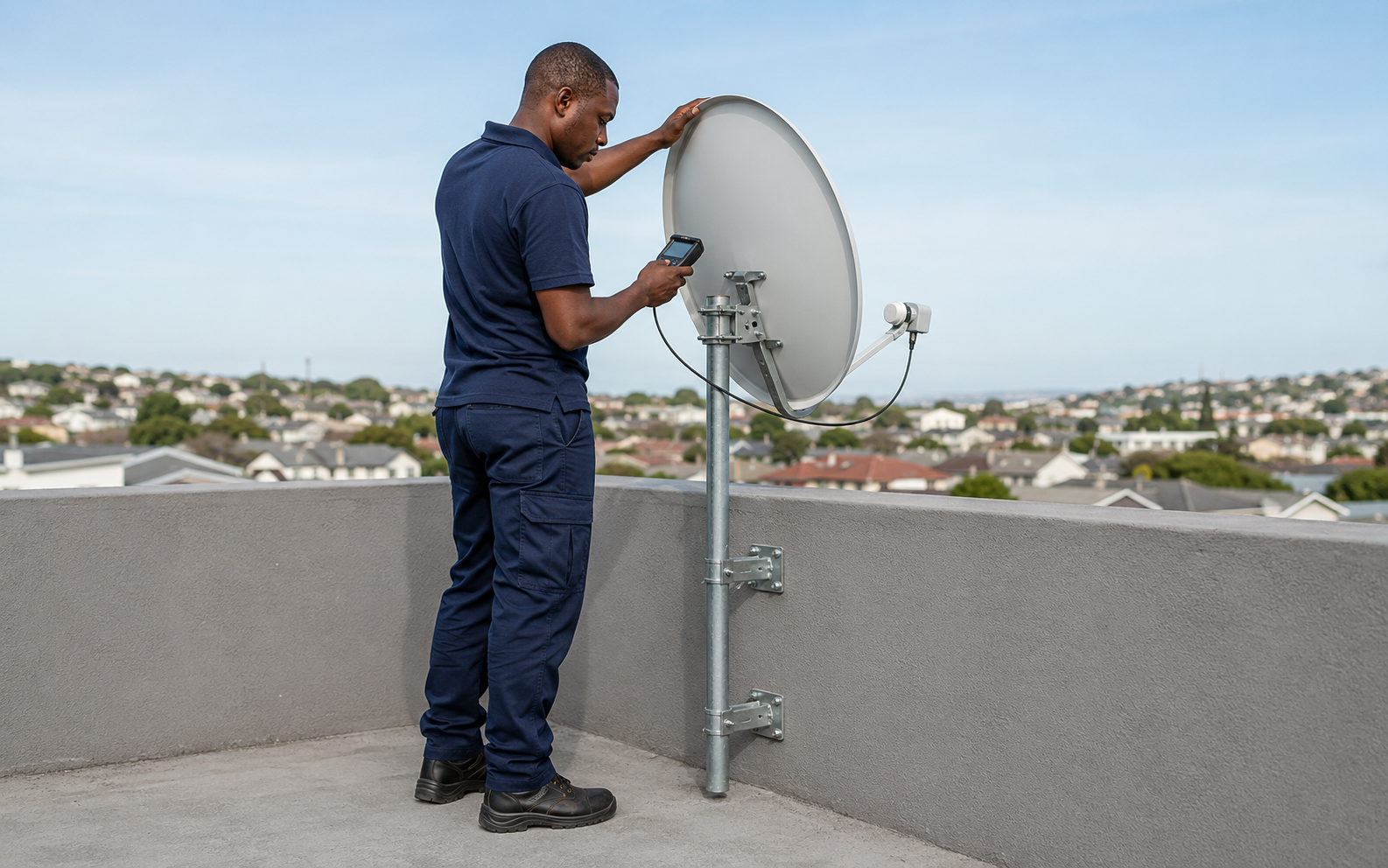
Get your satellite dish securely mounted and accurately aligned for dependable DStv reception. DStv Connect installs, replaces and realigns satellite dishes throughout Cape Town and surrounding areas.
Request a Satellite Dish Installation Quote
Fill in the form below and our team will contact you about your satellite dish installation or alignment.
Professional Satellite Dish Installers in Cape Town
The position, mounting and alignment of a satellite dish directly affect the quality of the signal reaching your DStv decoder. A dish that is poorly positioned, incorrectly aligned or attached to an unstable surface can cause missing channels, pixelation, intermittent reception or complete signal loss.
DStv Connect provides satellite dish installation and alignment for houses, flats, offices and other properties across Cape Town. We can install a new dish, replace damaged equipment, realign an existing dish or reposition it when the original location is no longer suitable.
The installation is planned around the decoder, property and intended viewing arrangement. The required dish, LNB and cabling must work together as one complete signal path.
New DStv Satellite Dish Installation in Cape Town
A new satellite dish installation begins with identifying a position that provides a clear line of sight and allows the equipment to be mounted securely.
The dish should not be placed where trees, walls, neighbouring buildings or planned property changes are likely to obstruct the satellite signal. The position should also allow the cable to reach the decoder without unnecessary exposure or unsuitable joins.
DStv recommends an 80cm satellite dish for its current installations. The correct LNB depends on the decoder and whether the system will serve one decoder, an Explora or an XtraView arrangement.
Once mounted, the dish must be aligned and the LNB positioned correctly. Signal strength and quality are then tested at the decoder before the installation is completed.
What a Satellite Dish Installation Includes
The exact work depends on the property, decoder and equipment already available.
A DStv satellite dish installation may include:
- Selecting a suitable mounting position
- Installing a secure mounting bracket
- Fitting an 80cm satellite dish
- Installing a compatible standard or Smart LNB
- Routing RG6 satellite cabling
- Fitting connectors and checking cable connections
- Setting the dish direction and elevation
- Adjusting the LNB position
- Testing signal strength and signal quality
- Connecting and configuring the decoder
- Checking reception across the available channels
Existing brackets, dishes, LNBs and cables can be reused when they are compatible, stable and in suitable condition. Damaged or unreliable components may need to be replaced.
Request a Satellite Dish Installation Quote
Fill in the form below and our team will contact you about your satellite dish installation or alignment.
DStv Dish Alignment and Realignment in Cape Town
Satellite dish alignment involves setting the horizontal direction, vertical angle and LNB rotation required to receive a stable signal. These settings must be fine-tuned at the property rather than estimated from a general direction.
A dish may require realignment after strong wind, roof maintenance, building work or accidental impact. Mounting bolts can also loosen gradually, allowing the dish to move whenever weather conditions change.
Common signs of poor dish alignment include:
- E48-32 or searching-for-signal errors
- Pixelated or freezing pictures
- Missing channels
- Signal loss on certain channels
- Reception that fails during mild rain
- Intermittent signal during windy conditions
- A dish that appears loose or displaced
The dish, bracket and mounting surface should be inspected before alignment is adjusted. A structurally damaged dish cannot always be corrected through realignment alone.
Signal strength and signal quality are checked during the adjustment. A strong reading without sufficient quality may still produce unstable reception, making accurate fine-tuning important.
When a Satellite Dish Should Be Replaced
A serviceable dish that has moved out of position can often be realigned. Replacement becomes more appropriate when the physical condition of the equipment prevents it from maintaining a stable signal.
A satellite dish may need replacement when it is badly bent, warped, deeply corroded or damaged by impact. Severe rust around the mounting points or LNB arm can also weaken the installation.
The bracket and mounting hardware should be assessed separately from the dish. A good dish attached to an unstable or corroded bracket may continue losing alignment until the supporting hardware is replaced.
An incorrectly sized dish may also need to be upgraded. DStv recommends an 80cm dish for current decoder installations, including its Explora models.
Replacing the dish will not resolve faults caused solely by damaged cabling, a faulty LNB, incorrect decoder settings or an account-related error. The complete signal path should be assessed before replacement equipment is installed.
Secure Satellite Dish Mounting and Site Selection
The satellite dish must be attached to a stable surface that can support the bracket and resist movement. A mounting position that flexes or vibrates can cause the dish to lose alignment over time.
The most suitable position varies between properties. Wall, roof and pole-mounted arrangements can be considered where the surface, access and satellite line of sight are appropriate.
The cable route should also form part of the site selection. A dish positioned far from the decoder may require a longer cable run, additional protection and more complex routing through or around the property.
Outdoor connections must be properly fitted and protected against moisture. Loose or exposed connectors can allow water to enter the cable and gradually reduce signal quality.
The installation should remain accessible enough for future inspection without placing the dish where it can easily be knocked, moved or obstructed.
Request a Satellite Dish Installation Quote
Fill in the form below and our team will contact you about your satellite dish installation or alignment.
Choosing the Correct DStv LNB
The LNB is fitted to the arm of the satellite dish and receives the reflected signal before sending it through the cable to the decoder. The correct type depends on the decoder and viewing configuration.
A Single View HD decoder can operate with different compatible LNB arrangements. An Explora generally requires a DStv Smart LNB with an 80cm satellite dish.
Most residential XtraView installations also use a Smart LNB. The selected model must support the number and combination of decoders being connected.
A Smart LNB is intended mainly for houses and other single residential properties using an individual dish. Flats, apartment blocks and complexes with communal satellite systems may require different distribution equipment.
The LNB position and rotation must be adjusted as part of the dish alignment. A compatible LNB that is incorrectly positioned can still result in poor signal quality or missing channels.
Satellite Cabling and Connections
RG6 satellite cable carries the signal from the LNB to the decoder. The cable, connectors and route all influence the reliability of the installation.
Outdoor cable can deteriorate through ultraviolet exposure, moisture and physical damage. Cable may also become crushed, cut or stretched during renovations and roof work.
Loose connectors can cause intermittent reception, while water entering a connector can lead to corrosion and signal loss. Unnecessary joins should be avoided where a continuous cable route is practical.
New cabling is routed from the dish to the decoder according to the property layout. Existing cable can be retained when it remains serviceable and provides stable signal quality.
Explora, XtraView and multi-room systems may require additional cable routes or specific connections. These requirements should be considered when the dish and LNB are selected.
Cape Town Wind, Rain and DStv Signal Stability
Cape Town’s wind and winter rain can expose weaknesses in a satellite dish installation. Strong wind may move a dish when the bracket or mounting bolts are not sufficiently secure.
Moisture can enter poorly protected connectors and contribute to corrosion around outdoor equipment. Coastal properties may experience additional exposure to salt-laden air, particularly where dishes and brackets face the prevailing weather.
Heavy downpours can temporarily weaken satellite reception through rain fade. This can occur even when the dish is installed correctly.
Signal loss during ordinary drizzle, light rain or overcast conditions can indicate that the dish is not optimally aligned or that the installation already has limited signal quality. Accurate alignment and suitable equipment provide a stronger operating margin but cannot eliminate every interruption during severe weather.
Request a Satellite Dish Installation Quote
Fill in the form below and our team will contact you about your satellite dish installation or alignment.
Satellite Dish Repositioning in Cape Town
A dish may need to be moved when its original position becomes obstructed or unsuitable. Tree growth, new walls, building extensions, solar panels and roof alterations can interfere with the satellite line of sight.
Repositioning can also be required when the original mounting surface has become unstable or a different cable route is needed.
The proposed position must be assessed before the dish is moved. It should provide clear satellite visibility, secure mounting and a practical route to the decoder.
Once remounted, the dish requires complete realignment and signal testing. Simply moving it to another wall without resetting its direction and LNB position will not restore reception.
Satellite Dish Installation for Homes and Businesses
DStv Connect installs and aligns satellite dishes for houses, townhouses, flats, offices, restaurants, guesthouses and other commercial properties.
A residential installation may support a single decoder, Explora, XtraView or several viewing points. The dish and LNB must be selected according to the intended configuration.
Commercial properties can require more complex signal distribution to serve several televisions or decoders. The dish position, cable routes and equipment must be planned around the size and use of the premises.
Where the property already has satellite equipment, it can be assessed before a new dish is installed. Reusing suitable components can reduce unnecessary replacement while still providing the required signal arrangement.
Satellite Dish Installation in Flats and Complexes
Flats and residential complexes may use a communal satellite system shared by several units. An individual dish should not be installed before confirming how the building distributes its DStv signal.
The existing wall outlets and communal equipment may already provide the signal required by the decoder. Explora and XtraView systems can require specific support from the shared installation.
Where an individual dish is permitted, approval may be needed from the landlord, body corporate or property manager. The property may also restrict external cable routes and approved mounting positions.
A DStv Smart LNB is not automatically suitable for a multiple-unit communal system. The building’s existing distribution equipment should be assessed before changes are made.
Request a Satellite Dish Installation Quote
Fill in the form below and our team will contact you about your satellite dish installation or alignment.
Factors Affecting Satellite Dish Installation Prices in Cape Town
The cost of satellite dish installation depends on the equipment and work required at the property.
Installing and aligning a new 80cm dish will differ from realigning a serviceable existing dish. Replacement brackets, LNBs, connectors and cabling can also affect the final price.
Other factors include the mounting position, accessibility, cable length, decoder type and number of connected viewing points. Explora and XtraView systems may require a Smart LNB and more complex configuration than a single-view setup.
Dish repositioning can require a new bracket and longer cable route. Flats, complexes and commercial premises may require additional assessment of shared infrastructure or signal-distribution equipment.
Providing information about the decoder, existing equipment and property layout helps us determine the likely requirements. The installation quote can then reflect the dish, LNB, cabling and work needed for the actual setup.
Why Choose DStv Connect for Dish Installation?
A dependable satellite installation requires secure mounting, clear line of sight, compatible equipment and accurate signal alignment.
DStv Connect considers the complete path from the dish and LNB to the cable and decoder. Existing equipment is checked before replacement is recommended.
We assist with new dish installations, alignment, realignment, replacement and repositioning for different decoder and property configurations throughout Cape Town.
Satellite Dish Installation and Alignment Across Cape Town
Professional satellite dish installation and alignment services are available throughout Cape Town and surrounding areas. Services include mounting new dishes, repositioning existing dishes, correcting alignment, securing brackets and checking signal quality.
- City Bowl and Atlantic Seaboard: Cape Town City Centre, Gardens, Vredehoek, Woodstock, Salt River, Sea Point, Green Point, Camps Bay and Hout Bay.
- Southern Suburbs: Observatory, Pinelands, Mowbray, Rondebosch, Newlands, Claremont, Kenilworth, Wynberg, Constantia, Plumstead, Diep River, Bergvliet and Tokai.
- Cape Flats and eastern areas: Athlone, Crawford, Bonteheuwel, Manenberg, Hanover Park, Grassy Park, Langa, Gugulethu, Nyanga, Philippi, Mitchells Plain, Khayelitsha, Delft, Belhar, Blue Downs, Eerste River, Mfuleni and Macassar.
- Northern Suburbs: Goodwood, Parow, Bellville, Durbanville, Brackenfell, Kraaifontein, Kuils River, Edgemead, Bothasig, Monte Vista, Plattekloof, Panorama and Fisantekraal.
- West Coast: Milnerton, Century City, Table View, Parklands, Bloubergstrand, Sunningdale, Dunoon, Melkbosstrand and Atlantis.
- South Peninsula: Muizenberg, Fish Hoek, Noordhoek, Kommetjie, Ocean View, Simon’s Town and Kalk Bay.
- Helderberg, Cape Winelands and surrounding towns: Somerset West, Strand, Gordon’s Bay, Grabouw, Stellenbosch, Kayamandi, Paarl, Mbekweni, Wellington, Franschhoek, Klapmuts, Malmesbury and Darling.
Request Satellite Dish Installation in Cape Town
Get professional assistance with new dish installation, replacement, repositioning and signal alignment. Request a quote from DStv Connect for satellite dish installation across Cape Town and surrounding areas.
Request a Satellite Dish Installation Quote
Fill in the form below and our team will contact you about your satellite dish installation or alignment.