
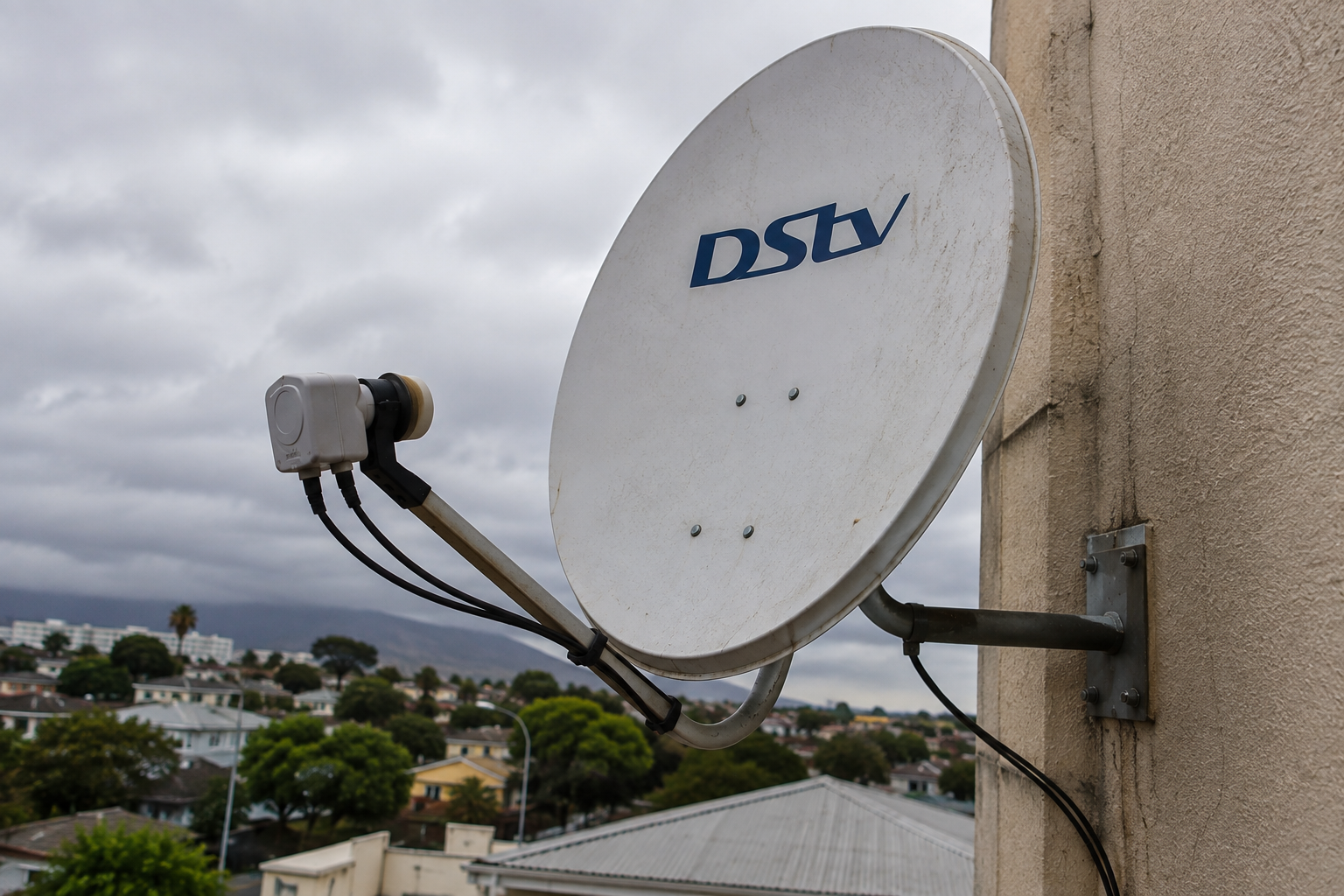
A DStv E48-32 error can be especially frustrating when you are not sure whether there is actually something wrong with your installation. The timing often makes the situation even more confusing. Your DStv may have been working perfectly all day, then a heavy rainstorm arrives and the picture disappears.
In that situation, the weather may genuinely be responsible.
But E48-32 can also appear when there is only light rain, cloudy weather or no rain at all. If the error keeps returning, disappears and then comes back whenever the weather changes, or remains on the screen long after a storm has passed, the weather may only be exposing an underlying problem with the satellite installation.
DStv classifies E48-32 specifically as a weather-related error, while the broader E48 error means the decoder is searching for an adequate satellite signal. DStv identifies severe weather, damaged cables, loose connections and an improperly aligned satellite dish among the possible causes of signal problems.
That distinction is important. A temporary interruption during a severe downpour is very different from a DStv system that cannot maintain a reliable signal during ordinary weather.
Request DStv Signal Troubleshooting
Is your DStv showing E48-32 and you are not sure whether the weather is responsible? Fill in the form below to request professional signal troubleshooting.
What Does DStv Error E48-32 Mean?
E48-32 means your decoder is experiencing a problem receiving the satellite signal it needs to provide normal DStv viewing.
The error itself does not necessarily mean that the decoder is faulty.
Your DStv system depends on several components working together. The satellite dish needs to receive the signal, the LNB needs to process it, the signal needs to travel through the relevant cabling and connections, and the decoder needs to receive and process that information.
If the signal becomes too weak or is interrupted somewhere along that path, the decoder may be unable to provide the normal picture.
This is why replacing the decoder should not automatically be your first response.
A dish that has shifted slightly, a deteriorating cable, a loose connection or a problem with the LNB can all affect the signal reaching the decoder. DStv’s own E48 troubleshooting information specifically points customers towards checking the weather and, when the weather is clear, checking the cables connecting the satellite dish to the decoder.
The challenge for the homeowner is working out whether the problem is temporary or whether the installation itself needs attention.
When E48-32 Really Is Caused by Heavy Rain
There are situations where you genuinely do not need an installer.
If a severe storm is moving through Cape Town and your DStv suddenly loses signal during an intense downpour, temporary rain fade is a reasonable explanation.
DStv explains that satellite signals can become weaker as they pass through raindrops. This phenomenon is known as rain fade, and heavy downpours can cause temporary signal interruptions.
You may notice the picture changing before the E48-32 message appears. Channels can begin freezing or pixelating, the audio may cut in and out, and eventually the signal may disappear altogether.
Once the rain becomes lighter, the signal may return without anyone touching the dish or decoder.
That is an important distinction.
There is no realistic way for a satellite installation to completely eliminate the effects of exceptionally heavy rainfall. DStv itself describes signal interruptions during heavy downpours as a characteristic of satellite systems.
So if your DStv works reliably in normal conditions and only temporarily loses signal during an unusually intense storm, there may be no physical fault to repair.
The first step in that situation is simply to allow the weather to pass.
How Long Should You Wait for the Signal to Return?
There is no single number of minutes that applies to every storm.
The severity and location of the weather matter. DStv explains that rain fade can be affected not only by weather at the customer’s location but also by storms elsewhere along the signal’s transmission path.
This means that the sky directly above your home does not always tell the entire story.
You might see the rain becoming lighter outside while the signal has not immediately returned. That does not automatically mean your dish has suddenly failed.
However, there is a point where repeatedly waiting for the weather to improve stops being a sensible solution.
If the storm has passed, conditions are relatively normal and E48-32 remains on the screen, it becomes more worthwhile to investigate the installation.
The same applies if the problem happens repeatedly during relatively ordinary rainfall.
Light Rain Should Not Automatically Cause E48-32
This is one of the most important points when trying to determine whether your DStv problem is genuinely weather-related.
DStv states that customers should not normally experience signal problems simply because the sky is overcast or there is drizzle or normal rainfall. If reception problems occur under those conditions, DStv says the dish may not be optimally installed or properly fine-tuned.
That gives you a useful benchmark.
Consider two different households.
The first household experiences E48-32 during an exceptionally heavy storm. Once the downpour passes, the channels return and the system works normally for weeks afterwards.
The second household experiences E48-32 whenever there is light rain. Sometimes the channels disappear during drizzle, and on other occasions the system loses signal on a cloudy day when there is barely any precipitation.
Those two situations should not automatically be treated as the same problem.
The first may be normal weather-related signal loss.
The second suggests that the installation may need to be examined.
Why Weather Can Expose an Existing Satellite Problem
Sometimes rain is not the real underlying problem.
Instead, bad weather can expose a system that was already operating with a weaker-than-ideal signal.
Think of the installation as having a certain amount of tolerance. Under good conditions, a system with slightly imperfect alignment or a deteriorating connection might still produce a usable picture.
When heavy rain weakens the satellite signal, that extra reduction may be enough to push the system beyond the point where the decoder can maintain reception.
The homeowner then sees E48-32 and naturally concludes that the rain caused everything.
The rain may have triggered the interruption, but the installation could still have an underlying weakness.
This is particularly relevant when the same pattern keeps repeating.
If your DStv loses signal during every moderate storm while previously being reliable in similar weather, it is worth investigating why the installation has become so sensitive to changing conditions.
A Satellite Dish That Is Slightly Misaligned Can Cause Trouble
Dish alignment is one of the areas an installer may need to investigate when E48-32 becomes a recurring problem.
A satellite dish needs to be positioned accurately. It is not enough for it to look as though it is pointing in roughly the correct direction.
A small change in position can affect reception.
Strong winds are an obvious potential cause. Over time, mounting hardware can also loosen or the structure supporting the dish can deteriorate. Physical work around the property may disturb the dish as well.
The problem is that a slightly misaligned dish may not always fail immediately.
It can continue producing an acceptable picture during favourable conditions, then become unreliable when rain or other interference weakens the signal.
This can create the impression that the dish only has a problem when it rains.
In reality, the weather may simply be revealing that the dish is no longer performing as it should.
DStv Connect provides satellite dish installation and alignment in Cape Town and surrounding areas, with the service covering secure mounting and accurate alignment for reliable DStv reception.
Strong Cape Town Winds Can Be a Useful Clue
Rain gets most of the attention when people talk about E48-32, but strong wind can also be an important clue.
If your DStv was working normally before a particularly windy period and the E48-32 error appeared afterwards, the timing is worth noting.
A dish does not need to be visibly hanging off its bracket for its position to have changed enough to affect reception.
You might look at it from the ground and think everything appears normal.
That does not necessarily tell you whether the dish is still accurately aligned.
If the problem started after strong winds and continues after the weather has settled, the dish and its mounting should be considered as part of the troubleshooting process.
Do not climb onto the roof to push the dish back into position. Apart from the obvious safety risk, moving the dish without properly checking the signal can make the problem worse.
Damaged Cables Can Cause E48-32 Even When the Weather Is Fine
The cable connecting the satellite equipment to the decoder is another part of the system that can affect reception.
A cable does not have to be completely severed to cause trouble.
Connections can loosen. Outdoor cable can deteriorate. A cable may be damaged during building work or when equipment is moved. Connectors can also develop problems over time.
DStv specifically recommends checking that the cables from the satellite dish are connected correctly to the decoder when weather is not responsible for the error.
This is one of the easier things a homeowner can inspect if the relevant connection is safely accessible.
If your decoder was recently moved, your television cabinet was rearranged or someone worked around the cable route, think about whether anything could have disturbed the connection.
Outdoor cabling deserves particular attention because it is exposed to environmental conditions for years.
A cable that has gradually deteriorated may continue to work until the signal becomes marginal enough for reception to fail.
The LNB Could Also Be Affecting Your Signal
The LNB is the small component mounted on the satellite dish that forms part of the signal reception system.
Because it is positioned outdoors, it is exposed to rain, wind, sunlight and temperature changes.
Like other equipment, an LNB can eventually develop a fault.
The symptoms can overlap with other signal problems. You might experience intermittent reception, channels disappearing, or a complete loss of signal.
This is another reason that E48-32 cannot be diagnosed simply by looking at the message on your television.
A technician may need to assess the different parts of the installation to determine where the signal is being compromised.
Replacing the decoder without checking the outdoor equipment could therefore leave the actual fault untouched.
What If E48-32 Appears on a Clear Day?
An E48-32 error during clear weather deserves a different level of attention.
If there is no heavy rain or storm activity to explain the interruption, you should start thinking about the physical installation and connections.
DStv’s E48 troubleshooting guidance specifically recommends checking the cables when the weather is clear and restarting the decoder after checking the connections.
If those basic steps do not resolve the problem, the issue may involve something that cannot be corrected from the remote control.
Possible areas for investigation include the dish, LNB, cabling, connectors, signal levels and the wider installation.
DStv Connect’s own service information explains that its troubleshooting work can involve checking the satellite dish, LNB, cabling, connectors, signal levels, decoder compatibility and installation area to determine the appropriate solution.
That is a much more useful approach than simply guessing which component needs replacing.
What If E48-32 Keeps Returning After the Signal Comes Back?
This is one of the biggest warning signs that the problem should not simply be blamed on the weather.
Imagine that the DStv signal disappears during a storm and then returns.
You might assume everything is fine.
But then the same thing happens again the following week during a relatively ordinary shower.
Then it happens again a few days later.
At that point, the pattern matters.
A recurring signal interruption suggests that something about the installation may be making it particularly vulnerable to conditions that should not ordinarily cause such severe reception problems.
DStv says that normal rainfall, drizzle and overcast conditions should not normally result in signal problems. If they do, the dish may not be optimally installed or properly fine-tuned.
So while one severe storm may not justify calling an installer, a repeated pattern is a different matter.
Can Trees or New Structures Cause an E48-32 Error?
Yes, changes around the satellite dish can potentially affect reception.
A tree may have grown considerably since the dish was installed. A new extension, awning, building or other structure may have altered the environment around the dish.
This can be easy to miss because nothing has actually happened to the satellite equipment itself.
The installation may have worked perfectly when the dish was originally positioned, while the surroundings have changed over the years.
If the signal has gradually become less reliable rather than failing suddenly during one particular storm, environmental changes around the dish are worth considering.
You should not attempt to climb onto a roof to inspect the dish or remove an obstruction yourself. If the equipment is difficult to access, an installer can assess the installation safely.
What Should You Check Before Calling an Installer?
There are several basic checks you can make without touching the satellite dish itself.
Start by looking at the weather. If there is an exceptionally heavy downpour, allow conditions to improve before assuming there is a permanent fault.
If the weather is clear, check the accessible cable connections between the satellite equipment and decoder. Make sure nothing has been accidentally disconnected or pulled loose.
DStv also recommends switching the decoder off at the wall plug, waiting at least 10 seconds and switching it back on after checking the connections.
It is also useful to pay attention to the exact pattern of the error.
For example:
- Does E48-32 appear only during very heavy rain?
- Does it happen during light rain or drizzle?
- Does it occur when the weather is completely clear?
- Does the signal return shortly after the storm?
- Did the problem begin after strong winds?
- Has the decoder or television recently been moved?
- Has any building or landscaping work taken place around the satellite dish?
- Does the problem affect one viewing point or multiple televisions?
These details can help narrow down what is happening.
You should not, however, treat this as an invitation to dismantle the satellite equipment yourself.
When You Should Stop Blaming the Weather
The weather is a reasonable explanation when the circumstances fit.
A severe storm arrives, the signal disappears, the rain eases and the picture returns.
That is relatively straightforward.
The situation becomes more suspicious when the circumstances do not fit.
If E48-32 occurs during mild weather, happens repeatedly, remains after a storm has passed, or began after a period of strong wind, there is a stronger reason to have the installation assessed.
The same applies when you are constantly restarting the decoder to restore reception.
A restart may be part of basic troubleshooting, but it cannot realign a satellite dish or repair a damaged cable.
If the same error keeps returning, there is value in finding out why.
Request Professional E48-32 Troubleshooting
If E48-32 keeps appearing despite clear weather and basic connection checks, fill in the form below to request professional troubleshooting.
Why Replacing the Decoder Is Not Always the Answer
When DStv stops working, the decoder is often the first piece of equipment people blame.
That is understandable because it is the device sitting next to the television and displaying the error.
But E48-32 is fundamentally connected to signal reception.
If the satellite dish has moved, replacing the decoder does not correct the dish alignment.
If the LNB has developed a fault, a new decoder does not repair the LNB.
If the cable has deteriorated, replacing the decoder leaves the damaged cable in place.
This is why professional fault finding can be more useful than replacing equipment based solely on the error message.
The purpose of troubleshooting is to establish where the problem actually is.
DStv Connect works with new and existing DStv systems and provides professional signal troubleshooting and repairs for homes, businesses and multi-unit properties in Cape Town and surrounding areas.
What an Installer Can Look For
A professional assessment can take a much broader view of the system than a homeowner can from the living room.
The installer can assess the condition and positioning of the satellite dish, inspect the LNB, look at cabling and connectors, and assess signal levels.
The installation area itself can also be relevant.
For example, if the dish is mounted in an exposed position, if the mounting appears compromised or if the surrounding environment has changed, those factors may influence the solution.
DStv Connect explains that its troubleshooting and installation work considers the existing equipment, decoder type, viewing requirements, available cable routes and installation conditions.
This matters because there is no single repair for every E48-32 error.
One household may need dish realignment.
Another may need a cable or connection repaired.
Another may have an LNB issue.
A different property may have a more complicated distribution setup serving multiple viewing points.
The correct solution depends on what the assessment finds.
What If You Live in a Complex or Use a Shared Satellite System?
Not every DStv customer has an individual dish installed on their own house.
Some apartment buildings, residential complexes and other properties use shared or communal satellite systems.
In those situations, an individual E48-32 error may not necessarily originate from equipment inside your home.
The distribution system serving multiple units may also need to be considered.
DStv’s own installation guidance notes that customers living in complexes, sharing a dish, using XtraView or connecting a decoder to multiple TVs may require advice from an installer because their setups are more complex than a standard single-dwelling installation.
DStv Connect provides communal and commercial DStv installation for complexes, hospitality properties, businesses and multi-unit buildings, including shared satellite systems and commercial DStv distribution.
This is important because the right person to contact may sometimes be the body corporate, property manager or the company responsible for the communal system rather than simply replacing equipment in your apartment.
What If Only One TV Has the E48-32 Error?
If you have more than one viewing point, the number of affected televisions can provide another useful clue.
If every viewing point loses signal at the same time, the issue may be further upstream in the satellite or distribution system.
If only one television or decoder is affected while another continues working normally, the problem may be isolated to that particular viewing point, decoder or cable route.
That does not provide a diagnosis by itself, but it gives an installer useful information.
DStv Connect provides additional DStv TV point installation and XtraView services, as well as communal systems for properties with multiple viewing points.
A more complicated installation simply means there are more parts of the signal path that may need to be considered.
What If E48-32 Started After Moving Your DStv?
Timing can be another important clue.
If you recently moved the decoder, television or DStv system and E48-32 appeared shortly afterwards, the installation should be considered.
Moving equipment can disturb connections or change cable routing.
If the satellite dish itself was relocated, the dish will also need to be correctly positioned and aligned at its new location.
DStv Connect provides DStv relocation and reinstallation services for moving systems to a new home, office or another position on a property, including removal, installation and signal setup.
If the error began immediately after relocation work, mention that when requesting assistance. It can help direct the troubleshooting process.
Is E48-32 the Same as Having a Faulty Subscription?
No. This distinction is important.
E48-32 is associated with a satellite signal problem, whereas other DStv error codes can relate to subscriptions, smartcards or channel access.
DStv’s error-code directory lists E48 as “Searching for Signal” and E48-32 as “Weather”. Other errors have completely different meanings, such as E16 for a scrambled service or E04 for a smartcard issue.
That means repeatedly checking your payment status is unlikely to solve an E48-32 problem if the underlying issue is a missing satellite signal.
The error message itself gives you an important clue about which part of the system needs attention.
Can You Still Watch DStv While the Satellite Signal Is Down?
If your decoder-based viewing has been interrupted by E48-32, DStv Stream may provide an alternative way to access content, provided you have an eligible service and an internet connection.
DStv says its streaming service allows customers to watch live channels and Catch Up content on compatible devices using an internet connection.
That can be useful during a temporary storm-related outage.
It should not, however, be treated as a permanent substitute for fixing a satellite installation that repeatedly loses signal.
If your home relies on the decoder for normal viewing and E48-32 keeps returning, addressing the underlying reception problem is still worthwhile.
How Cape Town Weather Fits Into the Picture
Cape Town weather can make the distinction between a temporary interruption and an underlying installation problem particularly relevant.
Heavy rain can cause rain fade, and DStv confirms that intense downpours can interrupt satellite reception.
Strong winds can also be a useful clue if an existing dish has shifted or its mounting has been affected.
But the weather should not become the automatic explanation for every signal problem.
If your DStv loses reception during a major storm and returns afterwards, there may be nothing wrong with the installation.
If it repeatedly loses reception during ordinary rainfall, light drizzle or cloudy weather, the installation may require closer attention. DStv specifically identifies those conditions as situations where signal problems can point towards a dish that is not optimally installed or fine-tuned.
That is a much more useful way to look at the problem than simply asking whether it is raining.
When Do You Actually Need a DStv Installer?
You do not necessarily need an installer every time E48-32 appears.
If there is an exceptionally heavy downpour and your signal disappears temporarily, waiting for the weather to pass may be enough.
An installer becomes more relevant when the problem is persistent, recurring or happening under conditions that should not ordinarily cause significant signal loss.
Professional assistance is particularly worth considering when you have already checked the accessible connections, restarted the decoder and the error remains.
It is also sensible to arrange an assessment if the problem started after strong winds, after moving equipment, after work was done around the property, or if the signal has gradually become less reliable over time.
The objective is not to sell you a new decoder or replace equipment unnecessarily.
It is to identify the component or condition that is actually affecting reception.
E48-32: Weather Problem or Installation Problem?
The most useful way to approach DStv E48-32 is to look at when it happens and what happens afterwards.
A severe downpour followed by a temporary loss of signal can be consistent with rain fade. DStv confirms that heavy rainfall can weaken satellite signals and cause temporary interruptions.
But light rain, drizzle, ordinary rainfall and overcast conditions should not automatically result in a DStv signal failure. If your reception is repeatedly affected under those conditions, DStv advises that the dish may not be optimally installed or properly fine-tuned.
Clear weather combined with persistent E48-32 is another reason to look beyond the weather. Cables, connections, dish alignment, the LNB and other parts of the installation may need to be checked.
The same applies when the problem started after strong winds, building work, moving the decoder or changing the satellite setup.
DStv Connect provides DStv repairs and signal troubleshooting, satellite dish installation and alignment, new installations, relocations, decoder upgrades, XtraView, additional TV points and communal and commercial DStv services in Cape Town and surrounding areas.
The important thing is not to assume that every E48-32 error requires a repair, but also not to keep blaming the weather when the pattern suggests something else.
If the signal disappears during an exceptional storm and comes back once conditions improve, give it time.
If E48-32 keeps returning during normal weather or refuses to disappear after the storm has passed, it is worth having the installation properly assessed.
That way, you can find out whether you are dealing with temporary rain fade or an actual signal problem that needs attention.
Request Your DStv Signal Assessment
Still dealing with E48-32 on your DStv? Fill in the form below to request professional signal troubleshooting.