
DStv Repairs and Signal Troubleshooting in Cape Town
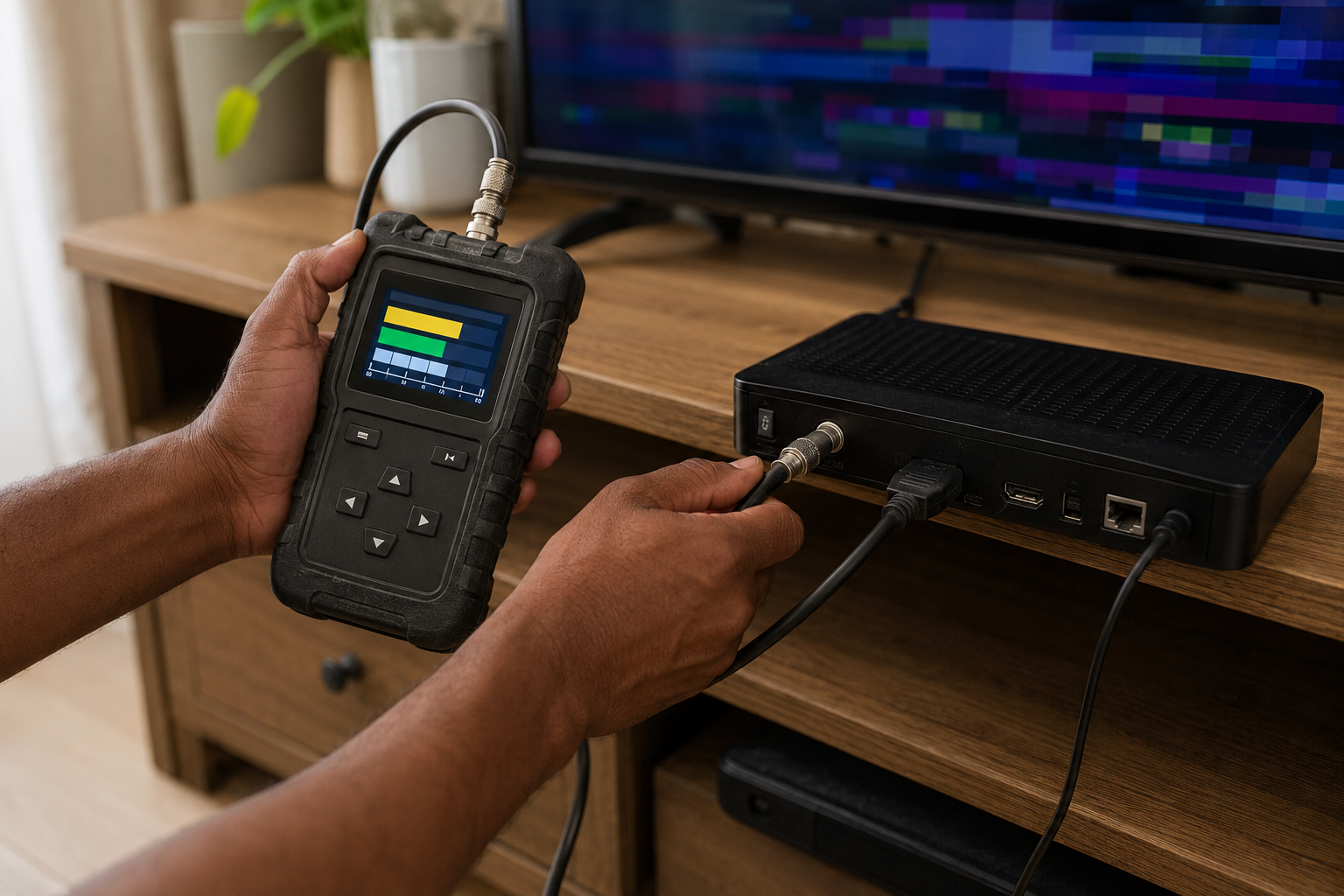
Restore your viewing with professional fault finding and DStv signal repairs. DStv Connect diagnoses and repairs reception problems for homes and businesses throughout Cape Town and surrounding areas.
Request a DStv Repair
Fill in the form below and our team will contact you about your DStv problem.
Professional DStv Repair Technicians in Cape Town
A DStv fault can originate anywhere between the satellite dish and television. The dish may have moved, the LNB may be failing, a cable may be damaged or the decoder may no longer be configured correctly for the installation.
Our DStv repair technicians in Cape Town inspect the complete signal path before recommending corrective work. This prevents a cable, LNB or decoder from being replaced without first identifying the actual cause of the problem.
DStv Connect provides signal troubleshooting for single-view, Explora, XtraView and additional TV point systems. We assist with faults affecting existing installations, including systems that have stopped working suddenly and reception that has gradually become less reliable.
Common DStv Signal Problems We Repair in Cape Town
Signal faults do not always result in a completely blank screen. A system can continue working while producing intermittent errors, missing channels or unstable picture quality.
Our DStv repair services cover problems such as:
- Complete loss of DStv signal
- E48-32 and searching-for-signal errors
- Pixelated, freezing or breaking pictures
- Sound cutting in and out
- Missing channels or signal loss on certain channels
- Reception that fails during wind or light rain
- Intermittent signal throughout the day
- A loose or visibly displaced satellite dish
- Faulty standard or Smart LNBs
- Damaged satellite cables and connectors
- Problems affecting additional TV points
- XtraView communication and signal faults
- Incorrect decoder or installation settings
The same symptom can have several possible causes. A pixelated picture may result from marginal dish alignment, a deteriorating LNB, damaged cabling or an obstruction affecting the satellite’s line of sight. Proper testing is therefore important before equipment is adjusted or replaced.
DStv No-Signal and E48-32 Repairs
E48-32 usually appears when the decoder is not receiving a usable satellite signal. Heavy rain can temporarily interrupt reception, but a persistent E48-32 error during clear weather can indicate a problem with the physical installation.
Possible causes include a misaligned satellite dish, loose cable connection, faulty LNB, damaged connector, water inside the cable or an obstruction blocking the signal path. The decoder may also require a restart or correct configuration after equipment has been disconnected or changed.
If the signal does not return after the weather clears and the accessible cable connections have been checked, the system may require professional diagnosis. Moving the satellite dish without the correct testing equipment can worsen its alignment and make the original fault more difficult to identify.
Our DStv signal troubleshooting process checks the dish, LNB, cabling, connectors and decoder configuration to determine where the signal is being interrupted.
Request a DStv Repair
Fill in the form below and our team will contact you about your DStv problem.
DStv Dish Realignment and Signal Repairs in Cape Town
A satellite dish must remain securely mounted and accurately aligned. Even a relatively small change in its angle can reduce signal quality or prevent the decoder from receiving particular channels.
Strong Cape Town winds, building work, roof maintenance, accidental impact and loose mounting hardware can gradually move a dish out of position. Rusted brackets or loose bolts may also allow it to shift whenever the wind increases.
Signs that a dish may require realignment include reception that deteriorates during mild weather, frequent pixelation, missing channels, repeated E48-32 errors or a signal that comes and goes in windy conditions.
The dish position, bracket and mounting surface are inspected before alignment is adjusted. Signal strength and quality are then checked to determine whether the dish can be realigned in its existing position or whether another fault is affecting reception.
A bent dish, unstable bracket or obstructed line of sight may require more than a simple adjustment. Where trees, new structures or alterations to the property block the satellite path, repositioning the dish may provide a more dependable solution.
DStv LNB Testing and Replacement
The LNB is mounted on the arm of the satellite dish and receives the reflected satellite signal before sending it through the cable to the decoder. A faulty LNB can cause complete signal loss, intermittent reception, missing channels or picture problems that become more noticeable during changes in weather.
Outdoor exposure can gradually affect the LNB casing and connections. Heat, ultraviolet exposure, moisture and coastal conditions can contribute to cracking, corrosion or water ingress.
A failing LNB should be tested before replacement because similar symptoms can also be caused by poor dish alignment or damaged cabling. The replacement must be compatible with the decoder and viewing arrangement. Explora and many XtraView systems require a suitable DStv Smart LNB, while other installations may use a different configuration.
After a replacement is installed, the LNB position, dish alignment and signal quality must be checked together. Replacing the LNB without confirming the rest of the signal path may leave another underlying fault unresolved.
DStv Cable and Connector Repairs in Cape Town
Satellite cabling carries the signal from the LNB to the decoder. Damage anywhere along this route can weaken or interrupt reception.
Cables can deteriorate through prolonged exposure to sunlight and rain, become crushed during renovations or be damaged where they pass around sharp edges. Moisture entering an outdoor connector can also cause corrosion that gradually reduces signal quality.
Loose connections behind the decoder or at a wall plate may produce intermittent faults, while a badly damaged cable can cause complete signal loss. Multi-room systems have additional connections that must be checked when only one television or decoder is affected.
DStv cabling repairs can include replacing damaged cable sections, fitting new connectors, correcting loose connections and improving unsuitable cable routes. Where an older cable run is no longer serviceable, replacing the full section may provide a more reliable result than repeatedly repairing individual faults.
Request a DStv Repair
Fill in the form below and our team will contact you about your DStv problem.
Finding the Cause of Intermittent DStv Reception
Intermittent faults can be more difficult to diagnose because the system may work normally during part of the inspection. The conditions under which the problem occurs can provide useful clues.
Reception that fails during wind can indicate a loose dish or unstable mounting bracket. Problems that appear after rain may point to water entering a connector, cable or LNB. Gradually worsening pixelation can be associated with marginal alignment, equipment deterioration or a developing obstruction.
When only certain channels are affected, the decoder may still be receiving part of the available signal while struggling with particular frequencies. This can result from poor alignment, an incorrect LNB position, a failing LNB or signal loss along the cable.
The full installation must be assessed rather than treating every intermittent problem as a decoder fault. Dish alignment, LNB performance, signal quality, cable condition and decoder settings all contribute to stable reception.
Decoder, Account and Installation Problems
Not every error displayed on a DStv decoder requires a physical repair. Some errors relate to subscription status, package access, smartcard validation or account synchronisation and may be resolved through DStv Self Service.
Our service focuses on faults involving the satellite signal, installation equipment, connections and decoder configuration. We can assess whether the decoder is receiving the correct signal and whether its settings are compatible with the installed dish and LNB.
A decoder that does not power on, repeatedly restarts or continues malfunctioning despite receiving a stable signal may require testing at a DStv service centre or authorised agency. Identifying this distinction can prevent unnecessary work on a satellite installation that is functioning correctly.
Where an older decoder is no longer suitable for the existing installation, we can also assist with the physical requirements for connecting a compatible replacement or upgrade.
DStv Repairs for Homes and Businesses in Cape Town
DStv Connect provides signal repairs for houses, flats, apartments, residential complexes and commercial properties. Each type of property can have a different installation layout and approach to fault finding.
A house may have an individual dish with a direct cable connection to the decoder. An apartment may receive its signal through a communal distribution system, while a guesthouse, restaurant or office may have several decoders and television points connected through shared equipment.
Where only one television or decoder has a problem, the fault may be located within that particular connection. When every television in the property loses signal simultaneously, the problem may be closer to the dish, LNB or shared distribution equipment.
The number of connected rooms, cable routes and distribution components must be considered when diagnosing faults in larger residential and commercial systems.
Request a DStv Repair
Fill in the form below and our team will contact you about your DStv problem.
Factors Affecting DStv Repair Prices in Cape Town
The cost of a DStv repair depends on the cause of the fault and the work required to correct it. A loose connector or straightforward dish realignment will differ from replacing an LNB, repairing a long cable route or restoring a multi-room system.
Repair prices can be affected by the equipment required, accessibility of the satellite dish, condition of the existing installation, cable length and number of connected television points. Complex communal and commercial systems may require more extensive testing than a single residential decoder.
Providing details about the error message, affected channels, decoder type and circumstances surrounding the fault helps us understand the likely problem. A DStv repair quote can then reflect the diagnosis, replacement components and work required for the installation.
Why Choose DStv Connect for Signal Troubleshooting?
Effective DStv repairs begin with finding the cause of the problem. Replacing individual components without testing the complete installation can result in unnecessary costs while leaving the original fault unresolved.
DStv Connect assesses the dish, mounting hardware, LNB, cabling, connectors and decoder configuration as parts of one connected system. The recommended repair is based on the fault identified during the assessment.
We assist with straightforward residential reception problems as well as faults affecting Explora, XtraView, additional TV points and shared systems. Where the problem falls outside the physical installation, we help identify whether account support or decoder testing may be required.
DStv Repairs Across Cape Town and Surrounding Areas
DStv repair and signal troubleshooting services are available for customers experiencing no signal, pixelation, missing channels, damaged cabling, loose connections, LNB problems and satellite dish alignment faults throughout Cape Town and surrounding areas.
- City Bowl and Atlantic Seaboard: Cape Town City Centre, Gardens, Vredehoek, Woodstock, Salt River, Sea Point, Green Point, Camps Bay and Hout Bay.
- Southern Suburbs: Observatory, Pinelands, Mowbray, Rondebosch, Newlands, Claremont, Kenilworth, Wynberg, Constantia, Plumstead, Diep River, Bergvliet and Tokai.
- Cape Flats and eastern areas: Athlone, Crawford, Bonteheuwel, Manenberg, Hanover Park, Grassy Park, Langa, Gugulethu, Nyanga, Philippi, Mitchells Plain, Khayelitsha, Delft, Belhar, Blue Downs, Eerste River, Mfuleni and Macassar.
- Northern Suburbs: Goodwood, Parow, Bellville, Durbanville, Brackenfell, Kraaifontein, Kuils River, Edgemead, Bothasig, Monte Vista, Plattekloof, Panorama and Fisantekraal.
- West Coast: Milnerton, Century City, Table View, Parklands, Bloubergstrand, Sunningdale, Dunoon, Melkbosstrand and Atlantis.
- South Peninsula: Muizenberg, Fish Hoek, Noordhoek, Kommetjie, Ocean View, Simon’s Town and Kalk Bay.
- Helderberg, Cape Winelands and surrounding towns: Somerset West, Strand, Gordon’s Bay, Grabouw, Stellenbosch, Kayamandi, Paarl, Mbekweni, Wellington, Franschhoek, Klapmuts, Malmesbury and Darling.
Request DStv Repairs in Cape Town
Get professional assistance with no-signal errors, pixelated pictures, dish alignment, faulty LNBs, damaged cabling and other reception problems. Request a repair from DStv Connect for DStv signal troubleshooting across Cape Town and surrounding areas.
Request a DStv Repair
Fill in the form below and our team will contact you about your DStv problem.